

The Ultimate Walling Guide: Metro Tiles
To complement the launch of our series, The Ultimate Flooring Guide last month, allow us to introduce you to The Ultimate Walling Guide series. After all, as your one-stop-shop for all things tiles and tiling accessories, you didn’t think we’d forget to show your walls some love, did you?
To kick things off, we’re taking a look at a kitchen and bathroom walling staple – metro tiles. What are they, why are they so popular and how can you incorporate this classic style into your interior approaches? Let’s explore…
What are metro tiles?
The walls of London and New York’s iconic underground stations were famously embellished with plain brick-shaped tiles in the early 1900s – a now-iconic and timeless design that birthed the name ‘mero tiles’.
Despite many of the tube stations in the Big Smoke receiving a design overhaul in recent years, the beauty and visual impact of subway tiles can still be witnessed today – from the colourful station signs of Regent’s Park and Russell Square to the impactful white corridors at Tottenham Court Road.
With a slim brick shape that’s instantly recognisable, metro tiles for bathrooms, kitchens and beyond have become highly sought commodities in the world of interior design. Those looking to replicate the statement style of subway stations past and present are often drawn to the broad spectrum of metro tile colours and finishes available, meaning they can often be powerfully paired with an assortment of colour schemes and design themes.
Metro tiles’ colours & finishes
To achieve as much interior impact as possible, it’s important you make a considered choice when it comes to your metro tiles’ colours and finishes.
For the finish, you typically have two options: flat or bevelled.
Flat or bevelled metro tiles?
Your choice of finish primarily depends on your interior approach and desired aesthetic.
To evoke the classic look of historic underground stations, opt for a flat finish. Powerful, simple and easy-to-clean, flat metro tiles provide a no-nonsense interior statement that lets your colour palette do the talking.
Alternatively, cleverly utilise the edges of bevelled metro tiles in interior spaces where you wish to add more texture and depth. Whatever shade you opt for, the unique finish of bevelled metro tiles is sure to add impact in any room.
Other finish considerations
Of course, flat and bevelled isn’t the only decision you need to make when considering the finish of your metro tiles. You’ll also need to pick between a matte or gloss, or (to really make a statement) even branch out into unique alternate options ranging from natural stone to glass finishes.
Metro tile colours
With metro tiles available in colours and shades galore, you really are spoilt for choice. This means, when it comes to your interior approach, the possibilities are quite literally endless.
For example, for cool and classic interiors, monochrome shades including white, cream, grey and black will provide maximum impact with minimal effort. At the other end of the spectrum, opt for funky and playful tones in bold and loud colours like red, blue, lime green and yellow that really make a statement.
Whatever metro tile colour you opt for, the key is to ensure cohesion with your desired effect and overall interior theme.
How to use metro tiles
So how do you ensure cohesion between colour and theme? Here are just some of the ways you can incorporate metro tiles into popular interior approaches in the kitchen and bathroom:
Bathroom metro tiles
Contemporary colour
Explore the metro tile colour wheel with a bathroom metro tile that’s as eye-catching as it is functional.
A staple of contemporary bathroom interior style is the emphasis of one dominant shade, so why not explore the eccentric colour options fit for a statement feature wall?
Find a tone that ticks all the boxes when it comes to energy and vibrancy for an impactful modern interior that’s sure to bring a new lease of life to your home.
Maximise space
A small bathroom doesn’t have to mean a big problem when it comes to deciding on your metro tiles.
On the contrary, smooth glass metro tiles enable a seamless walling option that not only looks stylish but also boasts amazing practical qualities. Not only are glass metro tiles super-easy to clean, making them ideal for the bathroom, but they also boast light-reflective qualities that can maximise the impression of space in any room. This allows you to turn dainty bathrooms into ones that feel nothing short of spacious havens.
Scandi chic
The Scandi approach has been on-trend for a number of years, and for good reason.
A simple way to pull off this classic minimalist approach with metro tiles in your bathroom is to opt for a clean finish with glossy white metro tiles and lay them in a traditional, vertical approach.
Pair with some hand-picked wooden bathroom cabinets and a stand-alone bathtub for the ultimate homely yet cutting-edge Scandi bathroom.
Kitchen metro tiles
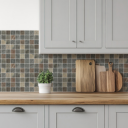
Stylish splashbacks
Metro tiles and splashbacks go together like bread and butter.
Of course, as the hub of everyday cooking and cleaning, the kitchen is prone to stains, splashes and spillages – enter metro tiles. With a winning combination of uncomplicated aesthetics and minimal maintenance, splashback metro tiles are the ultimate combination of style and practicality.
Modern industrial
Many modern kitchens have turned to industrial aesthetics for inspiration, and metro tiles can be the ideal way to incorporate these elements into your own space.
For something chic and contemporary, it’s easy to add metro tiles to the equation. With an array of sleek dark and metallic shades available, utilise your chosen tone for a statement backdrop and complete the look with subtle, monochrome features and accessories in eye-catching geometric shapes.
How to lay and grout metro tiles
One of the greatest appeals of metro tiles is their versatility. As we’ve already touched upon, the mixed-bag of colours and finishes available enables you to be flexible in your interior decisions – but the flexibility doesn’t end there.
How to lay metro tiles
Thanks to the brick-inspired dimensions of metro tiles, they can be cleverly installed in a number of creative ways. From vertical to horizontal, linear to striking patterns, these tiles can lay a number of different ways to achieve a number of different styles:

How to grout metro tiles
Metro tiles should be grouted with the same care and attention you’d grout any other tile. Typically small and in substantial-quality, metro tiles often feature plenty of grout lines, meaning getting your grouting right is key:
- As a rule of thumb, you should always allow tile adhesive a full 24 hours to cure before grouting
- Following the instructions provided on your chosen grout, mix until it forms a smooth paste
- Using a grout float at a 45° angle, press the grout firmly into any gaps with diagonal strokes and wipe away any excess using a damp sponge (be cautious not to remove any grout from between the tiles during this process)
- Leave for around 30 mins (or as instructed on the grout packet) before buffing the tiles with a dry cloth to remove and haze. Repeat until clean
But knowing how to grout metro tiles means more than having the right tools and know-how. You also need to think hard about what colour grout you plan to use. So what are the options? Put simply, a coordinating grout that almost matches your primary tile colour will help achieve a better blend in your approach. At the other end of the spectrum, a contrasting grout will serve to emphasise the edges and textures of your tiles.
So, when it comes to how to grout metro tiles, the vital first step is choosing how you plan on using the grout. Coloured grout is a great opportunity for you to either reinforce the existing feel to a metro tile or, contrastingly, reimagine its capabilities.
Metro tiles open up a whole world of interior possibilities and are an incredibly versatile choice for functional and fashionable walls. To start exploring yours, why not check out our comprehensive range of metro tiles that feature something for everyone?

Comments are closed here.